
Morgan County Court Records After Arrest
Court records after a jail arrest start with a simple split. The jail keeps the custody record. The court keeps the case record. The Morgan County Detention Center may receive a person after an arrest by the Sheriff's Office, Fort Morgan Police Department, Wiggins Police Department, Log Lane Village Police Department, or another agency. The Morgan County Sheriff's Office material says a person admitted to jail must be told the charge or other legal basis for confinement. That jail step does not, by itself, prove what the final filed court charge will be.
The criminal case is routed through Morgan Combined Court, which is part of Colorado's 13th Judicial District. The court location is 400 Warner Street, Fort Morgan, CO 80701. The clerk's phone is 970-542-5200, the fax is 970-542-7091, and the email address is MorganClerksOffice@judicial.state.co.us. The office is open Monday, Wednesday, Thursday, and Friday from 8:00 a.m. to 4:00 p.m.; Tuesday from 8:30 a.m. to 4:00 p.m.; and closed each day from noon to 1:00 p.m. Custody and booking details belong with Morgan County jail inmate records, while booking-photo access belongs with Morgan County jail mugshots.
Local timing: Weekday advisements and bond hearings for people held on a Morgan County case are listed for 2:15 p.m.
Find Morgan County Court Records
The first public search point for Morgan County court records after an arrest is the Colorado Judicial Branch docket search. The docket tool is useful for near-term hearing dates, party searches, case-number searches, and court-type filters. It is not a full document download site. Colorado Judicial Branch guidance says copies of court documents are not available directly through the Judicial Branch website, so a docket result often needs a follow-up request to Morgan Combined Court or the statewide record/document request form.
The docket search screen uses the following field set. Morgan County is in the 13th Judicial District, and the local courthouse is Morgan Combined Court.
| Field Label | Type | Required | Options / Format Notes |
|---|---|---|---|
| Judicial District | dropdown | optional, but one filter besides date required | 1st through 23rd Judicial District; Morgan County is 13th. |
| County | dropdown | optional | Includes Morgan County and all Colorado counties. |
| Courthouse | dropdown | optional | Includes Morgan Combined Court. |
| Court Type | dropdown | optional | Both, County, District. |
| Division | text | optional | Free text. |
| Date Range | dropdown | date/filter condition | 6 Months, 3 Months, 1 Month, 1 Week, Today, Specific Date. |
| Specify A Date | date/text | conditional | Used with Specific Date. |
| 4-Digit Year | text | optional | Case-number search component. |
| Case Class | dropdown | optional | C, CR, CV, CW, DR, JD, JV, M, PR, R, S, T. |
| Case Sequence | text | optional | Case-number sequence. |
| Party Search For | radio | optional | Individual, Business. |
| First Name | text | optional | Individual search. |
| Last Name | text | optional | Individual search. |
| Business Name | text | optional | Business search. |
| Attorney Search For | radio | optional | Attorney Name, Attorney Bar Number. |
| Attorney Bar Number | text | optional | Attorney bar-number search. |
| Attorney First Name | text | optional | Attorney-name search. |
| Attorney Last Name | text | optional | Attorney-name search. |
The Colorado Judicial Branch docket search screenshot below shows why the right court filters matter for Morgan County court records after an arrest.
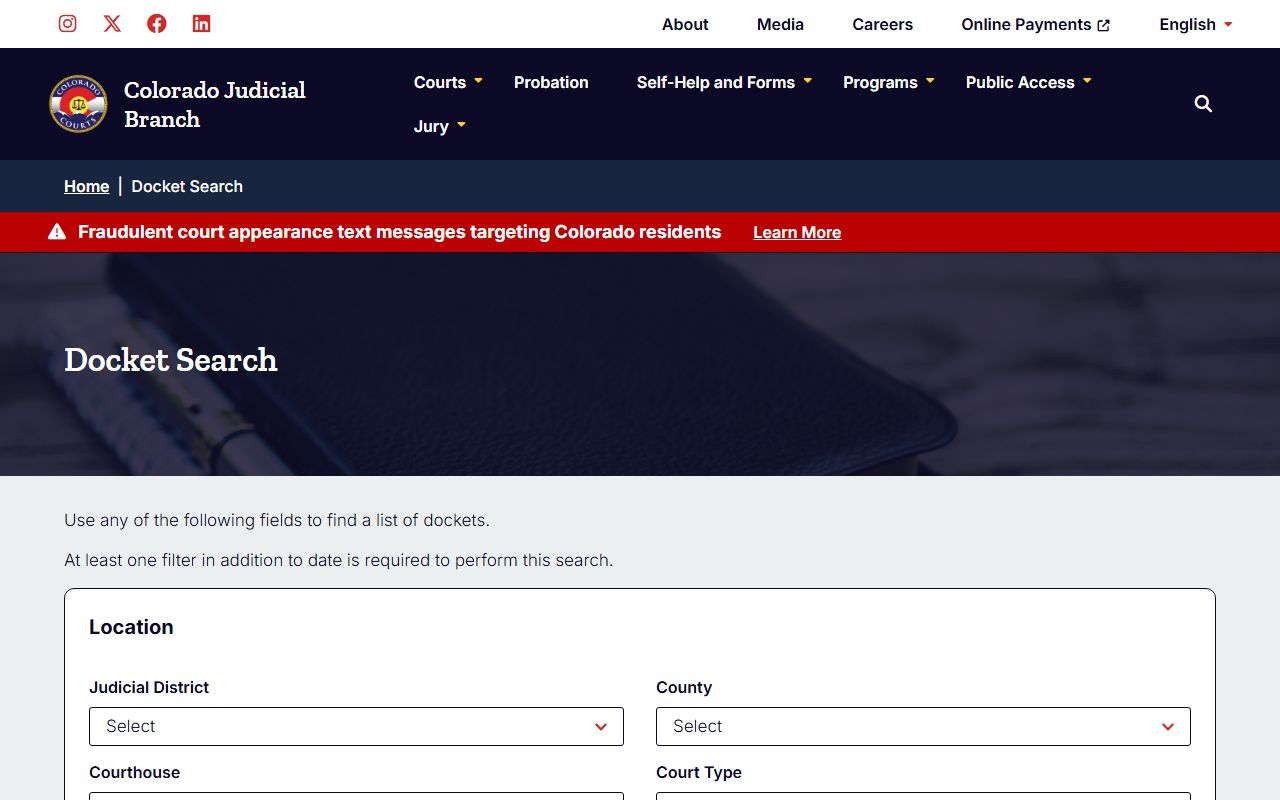
A search can start with district, county, courthouse, date range, case number, party name, or attorney details. A date-only search is not enough, so include at least one other filter when looking for a Morgan County arrest case.
Morgan County Arrest Charges
The 13th Judicial District Attorney's Office prosecutes Morgan County state felony cases, misdemeanor cases, and some traffic cases. DA Travis Sides is the district attorney, and Assistant District Attorney Rebecca Wiard is listed for the office. The Fort Morgan DA office is at 830 E. Platte Avenue, Ste H, Fort Morgan, CO 80701, with phone 970-467-0105 and weekday hours of 8:00 a.m. to 5:00 p.m. The district also covers Logan, Phillips, Washington, Sedgwick, Yuma, and Kit Carson counties.
The DA's public court-process material explains why jail booking charges and court records after a jail arrest may not match line for line. A deputy district attorney reviews law-enforcement reports under current law and decides what filing is proper. Charges may be filed after arrest. They may also be filed before arrest. Some cases may be filed directly into District Court through a grand-jury indictment. Felony offenses are handled in District Court, while misdemeanor and traffic offenses are handled in County Court.
| Document | Who Uses It | How It Fits Morgan County Court Records |
|---|---|---|
| Complaint | Law enforcement or prosecutor | Often starts a criminal case and states the alleged offense after an arrest or summons. |
| Information | Prosecutor | Formal charging document used by the DA to set out filed charges in many criminal cases. |
| Indictment | Grand jury | Can file some cases directly into District Court when a grand jury returns charges. |
Morgan County Court Copy Requests
After the docket search identifies a case, the next step for court records after a jail arrest is often a document request. The Colorado Judicial Branch record/document request form asks for requester contact details, case number, case type, year filed, county or court location, date of birth when known, party information, and other identifying facts. Criminal document options include Complaint/Information, Disposition/Sentence Order, Protection Order, Ticket, and Register of Action or ROA. The ROA is described as a brief case explanation that can include charges, sentences, and minute orders.
Colorado Judicial Branch guidance requests a response within three business days unless extenuating circumstances exist. That response is not always the final copy. The court may need to calculate fees, confirm the record location, review access limits, or redact information. The fee schedule is separate from Morgan County Sheriff's Office record fees, so do not merge court-copy charges with jail-record charges.
| Court Record Item | Fee |
|---|---|
| Copies | $0.25 per page |
| Transcript of judgment | $25 |
| Certificate of satisfaction | $20 |
| Certified or exemplified copy | $20 per document |
| Name search | $5 |
| Research or redaction after first hour | $30 per hour |
Morgan County Bond Hearings
Bond is part of the court records path because it is usually set at advisement. Morgan County Sheriff's Office custody material cites C.R.S. 16-4-102 and says people in jail must be brought before a court for bond setting as soon as practicable and no later than 48 hours after arrival, absent extraordinary circumstances. The Morgan County court page gives the local timing: weekday advisements and bond hearings for people held on Morgan County cases occur at 2:15 p.m.
A PR bond is a personal-recognizance release, which means release under court-set conditions without posting the full cash amount. A cash money bond is paid to the holding county. A surety bond involves a third party or bond arrangement. A no-bond hold, parole hold, immigration hold, federal hold, or another-county warrant can keep a person in custody even if one Morgan County bond is handled. Bond paperwork should include the defendant's next court date after posting bond.
| Bond or Hold Term | Practical Meaning |
|---|---|
| PR bond | Release on conditions without paying the full bond amount up front. |
| Cash money bond | Money posted to the holding county to secure release while the case is pending. |
| Surety | A third party or bond arrangement backs the defendant's court appearance duty. |
| Electronic monitoring | May allow a hold of up to 24 hours when fitting is required. |
| Separate hold | Another agency's legal hold may block release on the Morgan County case. |
Morgan County Charge Status
Charge status can change after arrest. A jail entry may list an arrest charge based on the first report or warrant. The DA may then file a different charge, add a charge, reduce one count, amend wording, or dismiss a count. The court record is the better source for filed charge status once a case exists, but the official court copy is still the record to use when exact wording matters.
| Status | What It Means |
|---|---|
| Pending | The charge remains open and has not reached final disposition. |
| Amended | The filed charge or count was changed by later filing or court action. |
| Reduced | The case moved to a lower charge level or lesser offense. |
| Dismissed | The count or case was ended without a conviction on that charge. |
| Disposition or sentence | The case reached an outcome, such as plea, verdict, dismissal, or sentence order. |
Morgan County Arrest Warrants
No official Morgan County sheriff active-warrant search, public warrant list, most-wanted page, or warrant-specific phone line was located in the official-source sweep. That matters because a docket search is not the same thing as an active-warrant database. A docket may show a missed court event, a case setting, or a warrant-related entry, but warrant status should be confirmed with Morgan Combined Court, the issuing agency, or the Morgan County Sheriff's Office.
A warrant can still explain why a person was booked. An arrest warrant authorizes arrest and jail processing. A bench warrant often follows a failure to appear or a violation of a court order. A fugitive or out-of-county warrant can create a hold that affects release. A search warrant is different because it authorizes a property search, not custody by itself. VINELink can help confirm current custody, but a no-result does not prove there is no warrant.
Morgan County Record Limits
Court records after a jail arrest need careful reading. A charge is an allegation. A conviction is a guilty verdict or accepted guilty plea. Colorado public-access rules also create limits. General public records are handled under CORA, C.R.S. 24-72-201 et seq. Criminal-justice records are handled under CCJRA, C.R.S. 24-72-301 et seq. Eligible Colorado arrest and criminal records may be sealed through court processes under C.R.S. 24-72-704 through 24-72-710, with CBI updating records after a signed order.
| Point | Charge | Conviction |
|---|---|---|
| Meaning | An accusation filed or listed in the case. | A guilty verdict or accepted guilty plea. |
| Timing | Can appear soon after arrest or after DA review. | Appears only after final plea or verdict. |
| Proof | Not proof that the person committed the offense. | Formal court outcome unless later changed by appeal or post-judgment order. |
Sealing and expungement are not the same. In common use, sealing restricts public access to a record while some agencies may still have limited access. Expungement is narrower and is often described as treating a record as though it did not exist. Colorado eligibility depends on the case type, age of the person, outcome, timing, and court order.
| Point | Sealed | Expunged |
|---|---|---|
| Public view | Hidden from ordinary public access after the court grants or applies sealing. | Removed or treated as not existing for the eligible record type. |
| Common route | Court sealing process, including some automatic sealing checks. | Specific statutory route for eligible records. |
| Who to check | Morgan Combined Court, Colorado Judicial Branch sealed-case search, and CBI after order entry. | The court or agency that controls the eligible record. |
Important: Morgan County court records after an arrest cannot be used as a consumer report for employment, housing, credit, insurance, or another FCRA-covered decision.